When the Trust With Your Executive Starts to Slip
Aug 18, 2026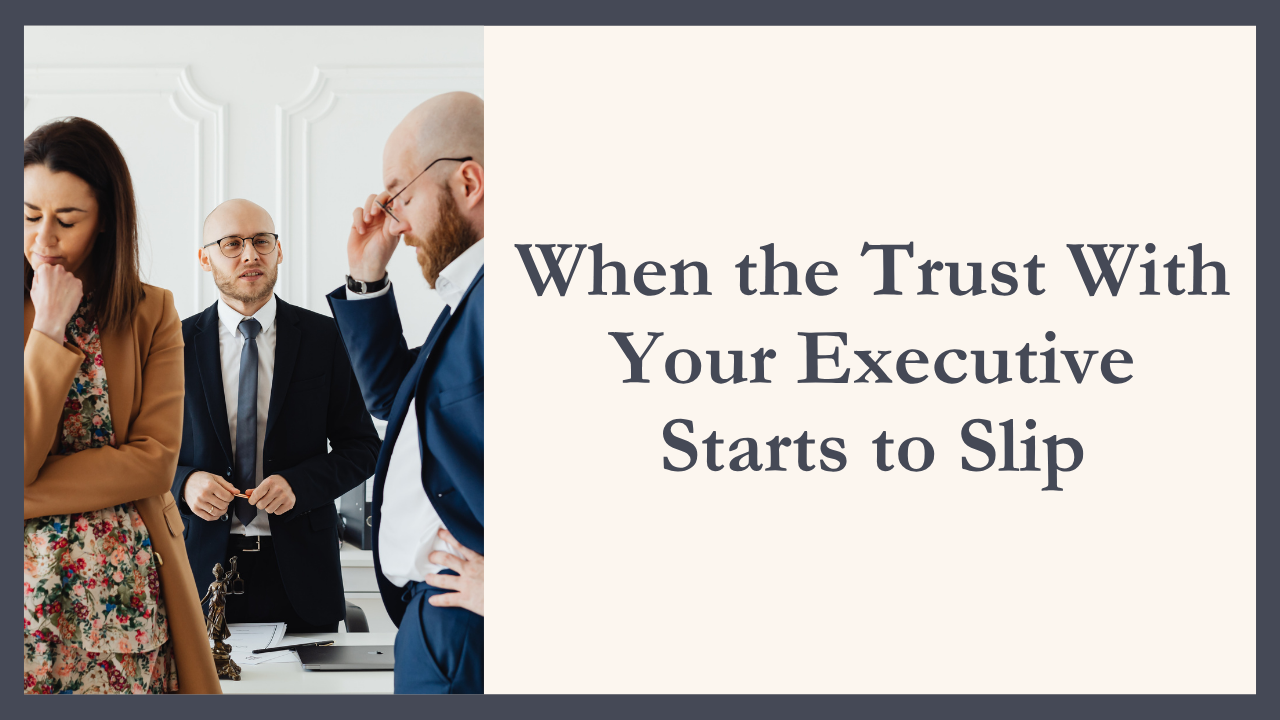
Trust in the Chief of Staff seat rarely breaks in a single moment. It thins. You notice it first in the things that stop coming your way. A decision gets made in a hallway conversation you would have been part of three months ago. A board deck circulates that you did not see in draft. Your executive answers a question you already answered, differently, and does not mention it. Nothing has been said out loud, and that is exactly what makes it hard to name.
Most people in the seat respond to this by working harder. They tighten the operating rhythm, over-prepare the briefing, and send more updates, hoping that visible competence will pull the relationship back into place. It almost never does, because the thinning was rarely about competence in the first place.
What the slip is usually made of
Three things tend to be underneath it. The first is a quiet change in what the executive needs. The person who hired you needed someone to build the systems and hold the operating cadence. Two quarters later, that work is running, and what they need now is a thinking partner in rooms where the systems are not the point. If you are still delivering the thing you were hired for while they have moved on to a different problem, you will feel the distance long before either of you can articulate it.
The second is an accumulation of small unreturned reads. You made a judgment call on their behalf, and it landed slightly wrong. Not wrong enough to correct, just wrong enough to notice. Then it happened again. Executives rarely give feedback on near-misses, so they absorb them silently and adjust by routing around you. By the time you feel the shift, they have already made a series of small decisions about what to hand you.
The third is the hardest to sit with. Sometimes the executive is under pressure that has nothing to do with you, and their instinct under pressure is to pull decisions closer rather than push them out. A board that has turned, a number that is not moving, a co-founder conflict they are not ready to say out loud. The seat feels the contraction first, and it is easy to read a company-level squeeze as a personal verdict.
Naming it without making it heavier
The instinct is to schedule a conversation about the relationship. That instinct is usually right and the framing is usually wrong, because an executive under strain does not have room for a meeting about how the two of you are doing. What they do have room for is a concrete question about the work.
Ask about the shape of the role rather than the state of the relationship. Something close to, I have been running the operating cadence and the briefing system since I started, and I want to make sure that is still the highest use of this seat. What would you want me holding ninety days from now that I am not holding today. That question gives them a legitimate place to say the thing they have been managing around, and it does it without asking them to reassure you.
If the answer comes back thin, that itself is information. Ask a narrower version. Name one specific decision you were not part of, without any charge on it, and ask what would have made it useful to have you in that conversation. You are looking for the mechanism, not the apology.
Repair is a rhythm, not a conversation
Trust that thinned over a quarter does not come back in a single meeting, and expecting it to is how good people talk themselves into leaving too early. What rebuilds it is a short series of visible, low-stakes calls where your judgment gets confirmed in front of them. Take one thing back off their plate that they genuinely dread, handle it cleanly, and tell them what you decided and why before they have to ask. Do that four or five times and the routing starts to reverse on its own.
Pay attention to how you are handling the ambiguity in the meantime, because the seat has a particular failure mode here. Uncertainty about your standing tends to show up as either withdrawal or over-function, and both of them read to an executive as a change in you. Holding steady while you do not yet know where you stand is genuinely difficult, and it is also the part of the work that most distinguishes a seasoned Chief of Staff from a talented one.
When it is not repairable
Some of these do not come back, and it is worth saying so plainly. If the executive has decided they want a different kind of person next to them, or if the thinning traces back to a values conflict rather than a scope mismatch, more proximity will not fix it. The signals are fairly consistent. Direct questions get deflected more than once. The scope conversation produces agreement in the room and no change afterward. Or you find that the version of yourself you have to be in that relationship is one you do not particularly like.
Recognizing that early is not a failure of the seat. It is the same judgment you apply to everything else in the role, turned toward your own situation, and it usually arrives well before you are willing to act on it.
The Chief of Staff seat runs on a relationship that almost no one teaches you how to maintain. Reading the drift accurately, and early, is part of the craft. Clarity is a form of care, and that includes the clarity you go looking for on your own behalf.